We seek to challenge the view that olfaction is an unimportant sensory modality for birds. Our lab addresses two major themes in biology: 1) Understanding the role of chemical communication in birds, particularly in reproductive and social contexts, and 2) Determining how symbiotic microbes affect host behaviour and fitness. We are especially focused on theme 1 at this time.
The field of avian chemical ecology is rapidly expanding and rich in opportunity. Our goal is to answer fundamental questions about the role of chemical communication in mate choice and sociality by i) determining how birds integrate multimodal information to arrive at a mate choice decision, ii) elucidating the importance of chemical cues in avian mate choice, iii) conducting behavioural experiments to evaluate the scope in which birds assess olfactory information, iv) identifying microbes that affect host odour and behaviour, and v) testing whether symbiotic microbiota impact host fitness.
We focus on birds because, while they possess sophisticated sensory capabilities and are among the world’s most well-studied taxa, their chemical communication has largely been ignored. Understanding vertebrate communication via this overlooked sensory modality within this well-studied taxonomic group has the potential to reshape how we think about sexual selection and the evolution of sociality.
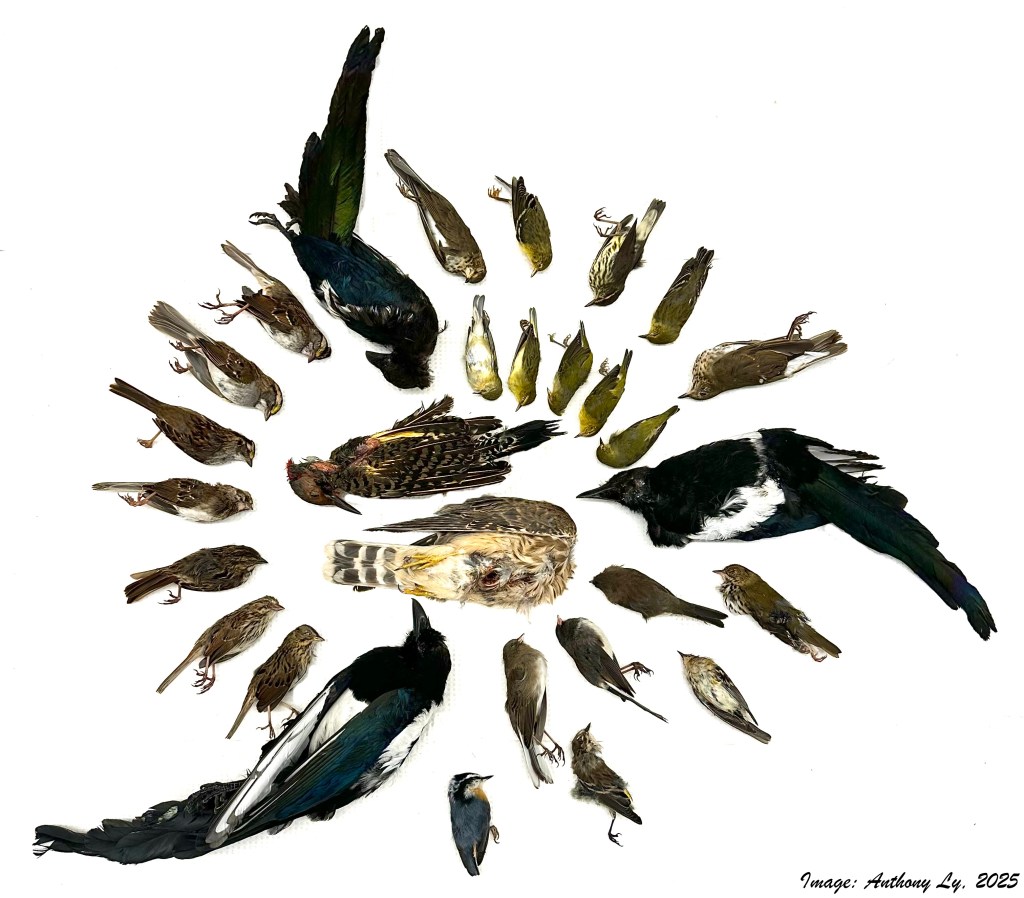
Dr. Grieves also conducts annual campus surveys to document bird-building collisions during spring and fall migration. The goal of this project is to build a robust dataset that identifys priority buildings that are candidates for retrofitting to reduce bird mortality on campus. This project is undergraduate-powered. Interested students are encouraged to contact Dr. Grieves and apply for this opportunity by registering in BIOL 380 (Research Experience in Biology) or BIOL480 (Biology Research), part of the USask Certificate in Biological Research.
Research interests:
- Animal communication
- Behavioural ecology
- Chemical ecology
- Microbial ecology
- Sexual selection and mate choice
- Breeding biology
- Social behaviour
- Ornithology
“Nothing makes sense in life except in the light of diversity”
Students of all ethnicities, races, genders, sexual orientations, and cultural backgrounds are welcome on our team – there is no place for hate here!
 grieveslab.com